



Kimchi: a blend of fiber and beneficial bacteria
Just like K-Pop, kimchi is impossible to avoid on a trip to Korea—and honestly, you wouldn’t want to. This iconic fermented cabbage turns up at almost every single meal, acting as the undisputed backbone of the Korean dining table. But it's not just a cultural staple anymore; scientists are now giving it serious side-eye and extensive research, thanks to its superpower ability to keep your gut microbiome happy and your overall health in check.
- Learn all about microbiota
- Microbiota and related conditions
- Act on your microbiota
- Publications
- About the Institute
Healthcare professionals section
Find here your dedicated section
Sources
This article is based on scientific information
Sections
About this article
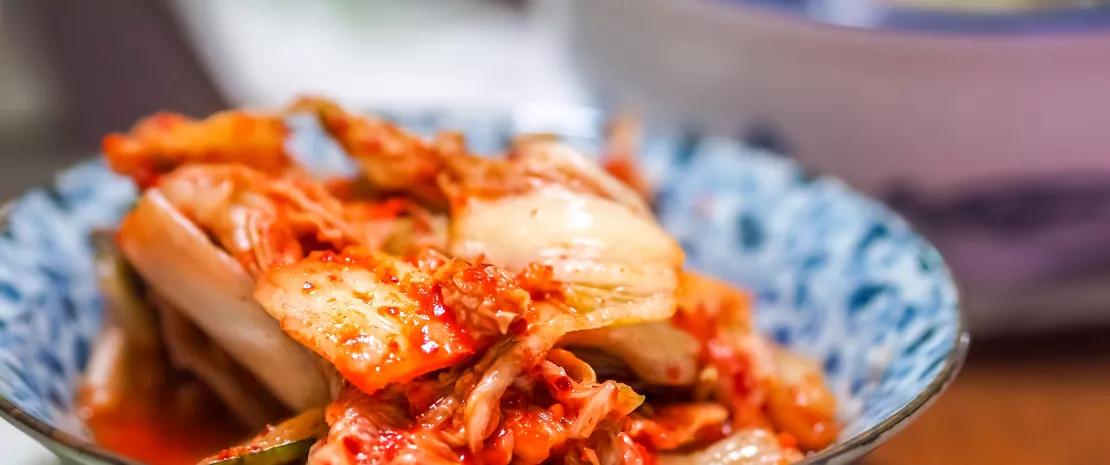
Kimchi is a traditional Korean side dish, typically made from cabbage or radishes depending on the recipe.1–3
Historically, it was prepared in winter using lacto-fermentation—a clever way to preserve vegetables for long periods.4 The cabbage is soaked in brine (a mixture of water and salt) for several weeks, allowing lactic acid bacteria to multiply. By producing lactic acid, these bacteria give kimchi its tangy flavor while naturally preserving it.5
It shares a resemblance with European sauerkraut—salted, fermented cabbage—though the type of cabbage and spices used are quite different.6 Kimchi is so deeply woven into Korean culture that Kimjang—the communal tradition of preparing vast quantities of kimchi for the winter—was inscribed on UNESCO’s List of Intangible Cultural Heritage of Humanity in 2013.
Everything You Need to Know About Kimchi
The word ‘kimchi’ originated from ‘chimchae’, the Chinese character, meaning salted vegetables.
Source : Park, 2014.2
42%
In 2019, 42% of Korean households still produced their own kimchi.
Source : Cha, 2024.4
1,78 MT
Koreans consumed a total of 1.78 million tons of kimchi in 2020.
Source : Cha, 2024.4
22
November 22 is designated “Kimchi Day” and was established in 2020 to promote the growth of the kimchi industry, preserve and advance kimchi culture, and raise awareness of kimchi’s nutritional value and importance.
Source : Kim, 2023.7
1500
According to Samguk sagi, the chronicle of the three kingdoms of Korea, people already consumed kimchi around 1,500 years ago.
Source : Cha, 2024.4
N°1
Cabbage kimchi was ranked as the most frequently consumed food by Koreans in 2020, with a 55% portion in the Korean diet, indicating that kimchi is consumed more frequently than rice, which is the staple food for Koreans.
Source : Cha, 2024.4
Cabbage + fermentation = a plateful of health benefits
Since it’s made from cabbage, kimchi is low in calories (18 kcal/100g) and rich in beneficial fiber. It also contains a range of compounds characteristic of the Brassicaceae family (the large family that includes cabbage, turnips, radishes, and mustard), whose health benefits may be almost as impressive as their tongue-twisting1(1) names.2,4
Kimchi also provides several vitamins—notably A, C, B1, and B2— as well as minerals—calcium, potassium, iron, and phosphorus.2,4
The health benefits of this Korean dish do not come from cabbage alone, they may also be attributed to the fermentation of the cabbage6 : compared to fresh cabbage, kimchi (fermented cabbage) has been associated with reductions in blood pressure, body fat, fasting blood sugar and total cholesterol… although these findings should be taken with a pinch of salt: the study involved only 22 people.8
Fermentation also enriches kimchi with live lactic acid bacteria, notably the genera Lactobacillus, Leuconostoc and Weissella , along with the valuable metabolites they produce.2,4,5,7
For example, eating kimchi appears to be associated with an increase in gut bacteria known for producing
(sidenote:
Short chain fatty acids (SCFA)
Short chain fatty acids (SCFA) are a source of energy (fuel) for an individual’s cells. They interact with the immune system and are involved in communication between the intestine and the brain.
Silva YP, Bernardi A, Frozza RL. The Role of Short-Chain Fatty Acids From Gut Microbiota in Gut-Brain Communication. Front Endocrinol (Lausanne). 2020;11:25.
)
—molecules recognized for their beneficial effects on gut health and metabolism—and with a reduction in far less desirable bacteria, such as Clostridium and Escherichia coli.9
More beneficial bacteria, fewer potentially harmful bacteria: kimchi may just be a tasty ally of your gut microbiota .
Fermented vegetables: good reasons to include them in your diet
Caution: effects… and dosage matter!
Given this promising nutritional profile, some researchers have explored the potential links between kimchi consumption and a surprisingly wide range of health outcomes, from obesity, cancer, atopic dermatitis, irritable bowel syndrome, and even cardiovascular health and skin health … 3,6,7,10–14
A few studies have been conducted, but they remain scarce and are often limited to Asian populations. In short, a little caution is warranted when interpreting the results, which remain inconclusive, and even when an effect is observed, it tends to be fairly modest.
Miracle foods do not exist, but a balanced diet does.
For example, with regard to obesity, some studies suggest that kimchi consumption may be associated with a potential beneficial effect. One large study that followed 115,726 Koreans found that moderate kimchi consumption—1 to 3 servings per day (perfectly common in Korea, perhaps a little ambitious for the average Westerner)—was associated with a lower prevalence of obesity, particularly among men. But caution: this does not mean there is a cause-and-effect relationship. Kimchi lovers may simply be Koreans who tend to lead healthier lifestyles overall.1
Nevertheless, another study—this time involving 3 grams of powdered kimchi daily (versus a placebo)—seems to support a potential role for kimchi in weight management.15 Let’s also put this “discovery” into perspective: eating more vegetables has been linked to better weight management for quite some time…
Of course, as with most things in nutrition, more is not necessarily better: beyond a certain level of consumption, any potential benefits may diminish, because kimchi, due to its recipe, contains a lot of salt, which can contribute to high blood pressure and is a risk factor for stomach cancer.1,2,16
The daily sodium intake from kimchi consumption in adults aged over 19 years is 500.1 mg/day (15.1% of the total daily sodium intake).
Source : Jung, 2024.1


